
News
CGM introducer needle development: Why measure penetration force after a tip passes visual inspection?
An early inspection sheet from our work on U-shaped introducer needles for continuous glucose monitoring (CGM) records eight bare needles. All eight passed visual inspection. When we compared two sets of penetration-force readings sample by sample, one set was generally lower. Even in that set, some readings exceeded the acceptance limit for that test. A photograph of the tip would miss this difference. So would reporting only the lowest reading.
At Shandong Lianfa, we have made both U-shaped needles and samples with molded plastic hubs. The same needle raises three separate questions. Does it penetrate the test medium under the agreed conditions? Does the open channel leave a clear path for the flexible sensor filament? Once the hub is in place, is that path still where the design calls for it?
What did the visual inspection actually cover?
The introducer needle supports the flexible filament during insertion and is then withdrawn. The tip initiates penetration, while the two channel edges travel alongside the filament for part of the stroke. We therefore describe the tip and the edges separately in our steel-needle inspection requirements. At the tip we look for breakage, curling or a hook. Along the channel we look for an edge folded inward or back on itself, or a local narrowing. A bright spot in a head-on photograph may disappear when the viewing angle changes. An edge that folds back into the channel is a different finding.
“Smooth surface” leaves too much open in a sample review. An engineer looking at the tip and a quality inspector looking along the channel can both approve the appearance while having checked different features.
How should a development team use penetration-force readings?
The sheet records dimensions, appearance, penetration force and the condition of the samples. It shows how needles with the same visual result can give different force readings. The comparison applies to that group of bare needles under those test conditions. For a new revision, specify whether the sample is a bare needle or an assembly with a hub, and agree on the test medium and fixturing. A bench force reading cannot be converted directly into the pain a wearer would feel.
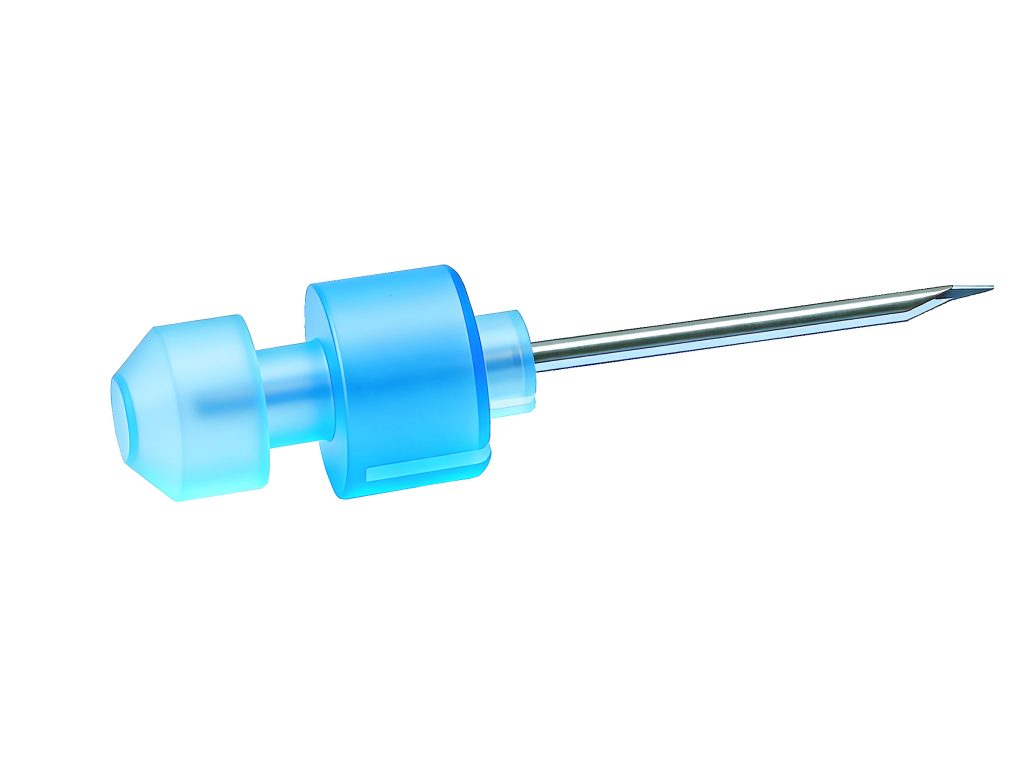
Why inspect the steel needle again after molding the hub?
On a bare needle the channel opening is fully exposed. Molding adds an interface where the steel emerges from the plastic. A plastic edge can encroach on the channel while the tip remains intact. The filament may then catch there during loading. If the needle rotates inside the hub, the outside of the part can look the same even though the channel now faces a different direction.
In our 2026 finished-part inspection requirements, we listed three checks separately: plastic obstructing the channel, needle orientation relative to the hub, and damage to the tip or channel edges. Incoming inspection covers the steel needle. Finished-part inspection examines the assembled geometry. For an inserter development team, a useful review brings together the hub-mounted sample, the matching filament revision and its mating parts so the team can observe both insertion and withdrawal.
If you are evaluating a CGM introducer needle, tell us whether this round concerns penetration resistance, filament passage or alignment after hub molding. Shandong Lianfa can review a drawing or sample with your team, define the scope of prototyping and agree on an acceptance method. Discuss an introducer needle sample with Shandong Lianfa